Conduit fill calculator: how many cables fit?
By the Hewer team · · 1 min read
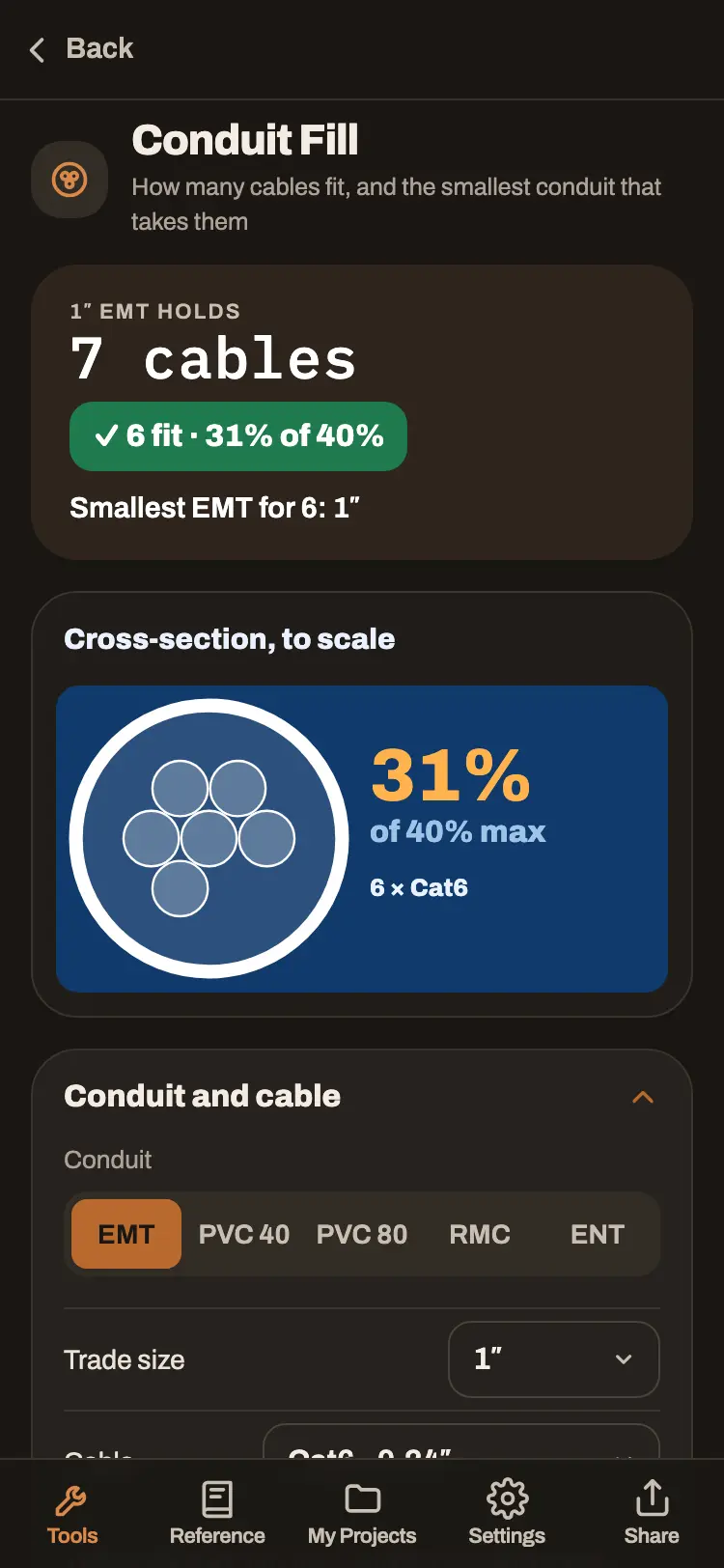
Pulling one cable too many through a conduit costs an afternoon. Conduit Fill tells you before you start how many cables fit, how full the pipe is, and the smallest size that takes what you need.
What Conduit Fill works out
- How many of your cable fit in the conduit you picked.
- The percent fill for the count you enter, against the allowed fill.
- The smallest conduit of that type that holds your cables.
- A to-scale cross-section of the conduit and cables.
How to use it
- Pick the conduit type: EMT, PVC, rigid metal or flexible.
- Pick the trade size.
- Pick the cable or wire, and how many you need to pull.
- Read whether they fit, and the smallest conduit that works.
Tips from the field
- Plan for pulls you'll make later. A pipe at its limit today has no room for the next circuit.
- Bends add pulling effort. A full conduit with several bends is a hard pull even when it's legal.
- Pair it with Conduit Bending to lay out the run.
The Toolkit does the arithmetic. Your local code, the edition your permit is under, and your inspector have the final word, so check with them before you build.
Free, and no account needed
The Hewer Trade Toolkit is free. It runs in any phone browser, saves your last inputs, works in feet and inches or metric, and keeps layouts in job folders you can export as a PDF. If you run a crew, the same calculators are inside Hewer's crew app, next to the jobs, the schedule and the clock-in.
Questions
How do I calculate conduit fill?
Add up the cross-section areas of the cables and compare them to the inside area of the conduit and the fill limit your code allows. The calculator does the adding and the comparison.
Which conduit types does it cover?
EMT, PVC (schedule 40 and 80), rigid metal conduit and ENT, in the common trade sizes.